Tomorrow of the Caojiaxiang Workers’ Village
– Renovation and Regeneration of an Intramural Village
Academic project by a team of two individuals: MA Rui, AN Chengyu, instructed by SHI Jingsong, at school of Architecture, Southwest Jiaotong University, Mar 2022-May2022. The selected documents below are my individual contributions to the project reorganized by myself. My role in the teamwork included context research, concept pitching, documentation, modeling, diagrams, rendering, and actively coordinating the teamwork.
Key words: Visual Narrative, Urban Mapping, Cultural and Social Context, Research-oriented Design
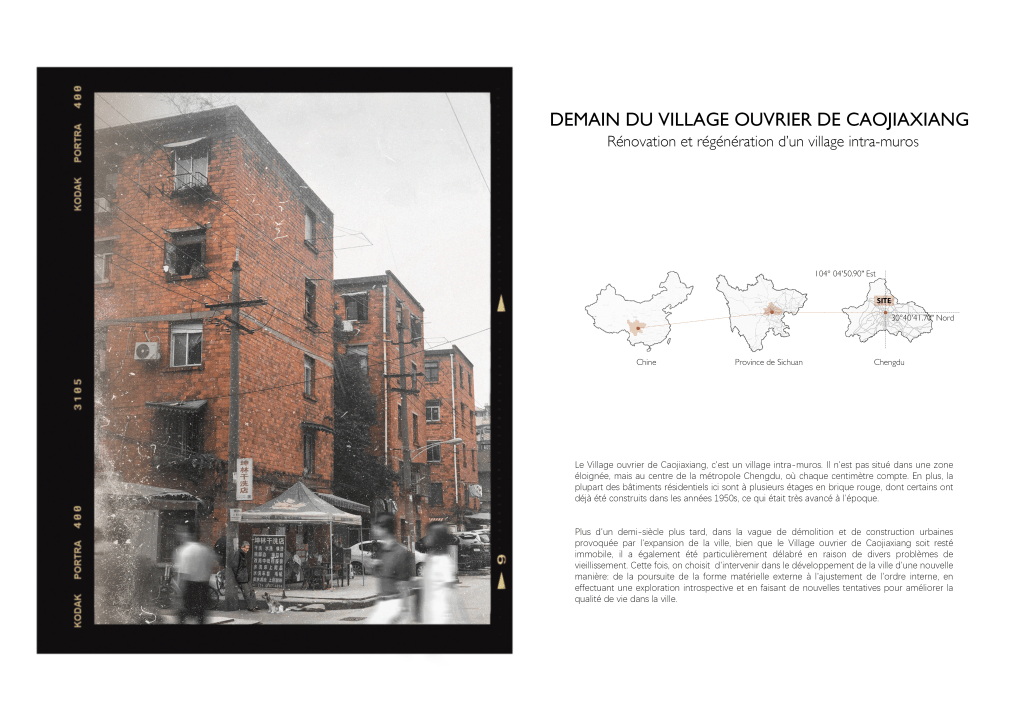
The Caojiaxiang Workers’ Village is an intramural village. It is not located in a remote area but in the heart of the metropolis Chengdu, where every centimeter counts. Moreover, most of the residential buildings here are multi-storey red brick structures, some of which were already constructed in the 1950s, which was very advanced at the time. More than half a century later, in the wave of urban demolition and construction caused by the city’s expansion, although the Caojiaxiang Workers’ Village remained stationary, it also became particularly dilapidated due to various aging problems. This time, we took the bottom-top approach to intervene in the city’s development: instead of pursuing fancy materiality, we turned to the “situation”, conducting introspective exploration, and making new attempts to improve the quality of life in the city.
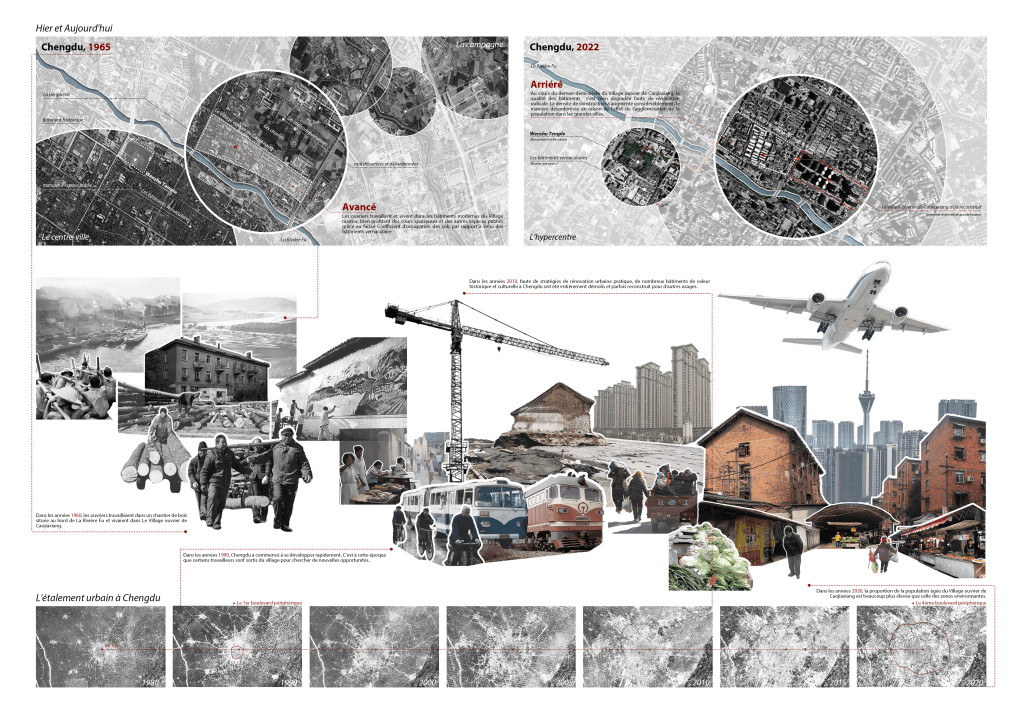
This document seeks to explore and represent the metamorphosis in terms of the social and cultural context of the Caojiaxiang Workers’ Village. It has undergone a complete transformation from rise to decay. In the 1960s, workers inhabited Caojiaxiang Workers’ Village while working in a wood workshop along the Fu River. By the 1990s, Chengdu’s rapid development led some to seek opportunities elsewhere. In the 2010s, historic buildings in Chengdu faced demolition due to urban renewal. Today, the population of elderly residents in Caojiaxiang Workers’ Village far exceeds that of surrounding areas.
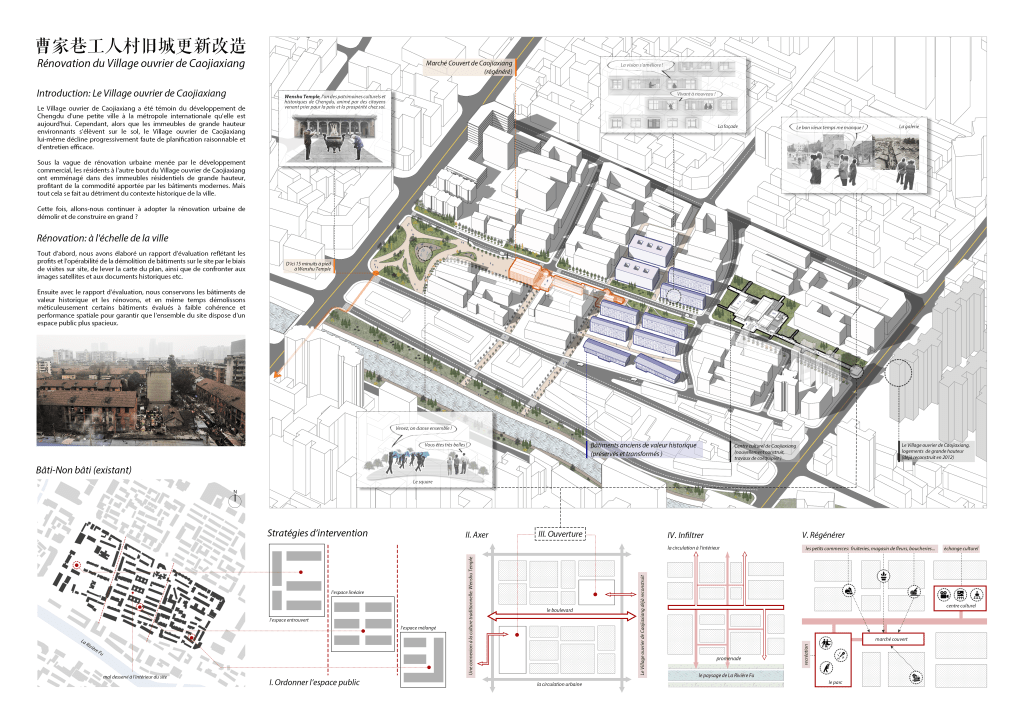
The Caojiaxiang Workers’ Village has seen Chengdu grow from a small town to today’s international metropolis. Yet, while modern skyscrapers surround it, the village itself is declining due to poor planning and upkeep. As commercial development leads to urban renewal, residents are moving into high-rise buildings, leaving behind the village’s historical charm. To decide on the village’s future, we’re evaluating the benefits and feasibility of demolishing some buildings while preserving others of historical value. This will ensure the site has more open public spaces.
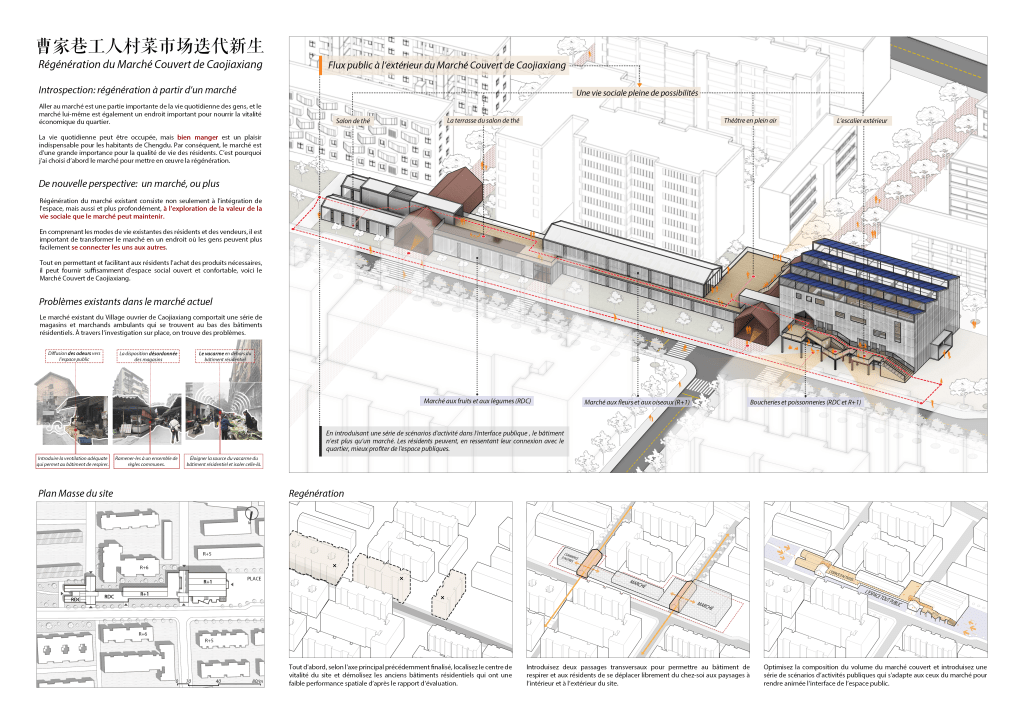
Introspection – Regeneration from a Market: Daily life can be busy, but eating well is an essential pleasure for Chengdu residents. Therefore, the market is of great importance to their quality of life. That’s why I chose to start the regeneration process with the market.
New perspective – A market, or more: Regenerating the existing market involves not only integrating space but also delving deeper into the social value it can uphold. By understanding the residents’ and vendors’ existing lifestyles, it’s crucial to transform the market into a place where people can easily connect with each other. While facilitating residents’ purchases, it should also provide ample open and comfortable social space, such as the Covered Market of Caojiaxiang.
Existing issues in the current market: The existing market in Caojiaxiang Workers’ Village (see collage on the left-handed column ) consists of a series of shops and street vendors located at the base of residential buildings. Through on-site investigation, several problems have been identified, which will be respectively responded to later when conceiving the new one.
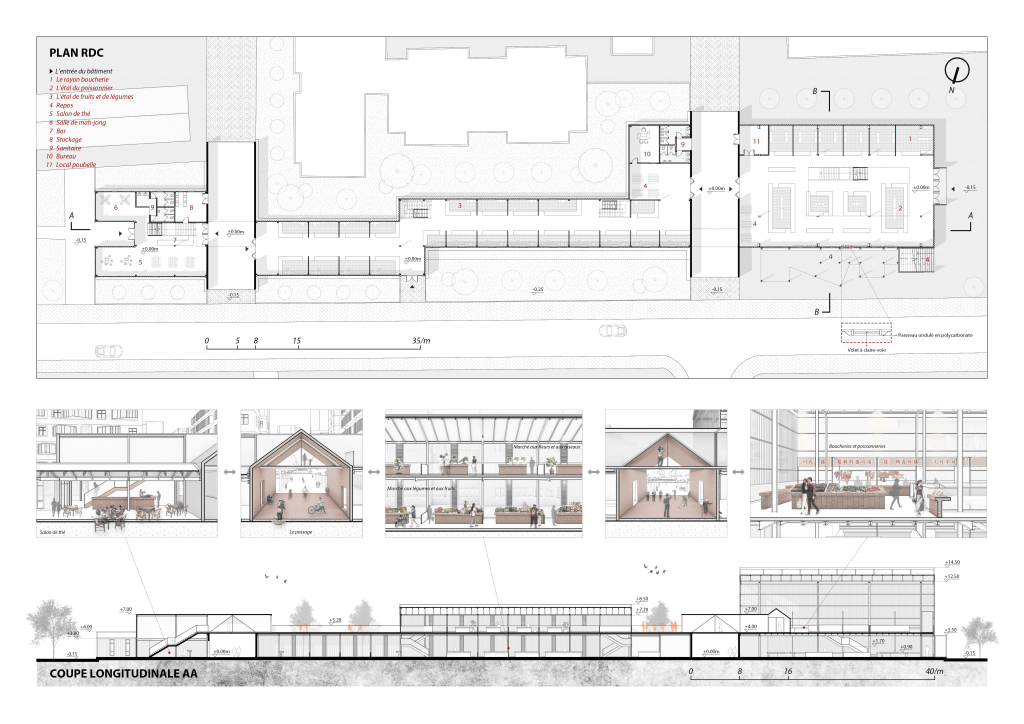
In between the section and the first-floor plan, there’s this sensational sequence of spatial scenarios that showcase how different scenes can be lined up to bring about something more vivid while functioning each in their own way.
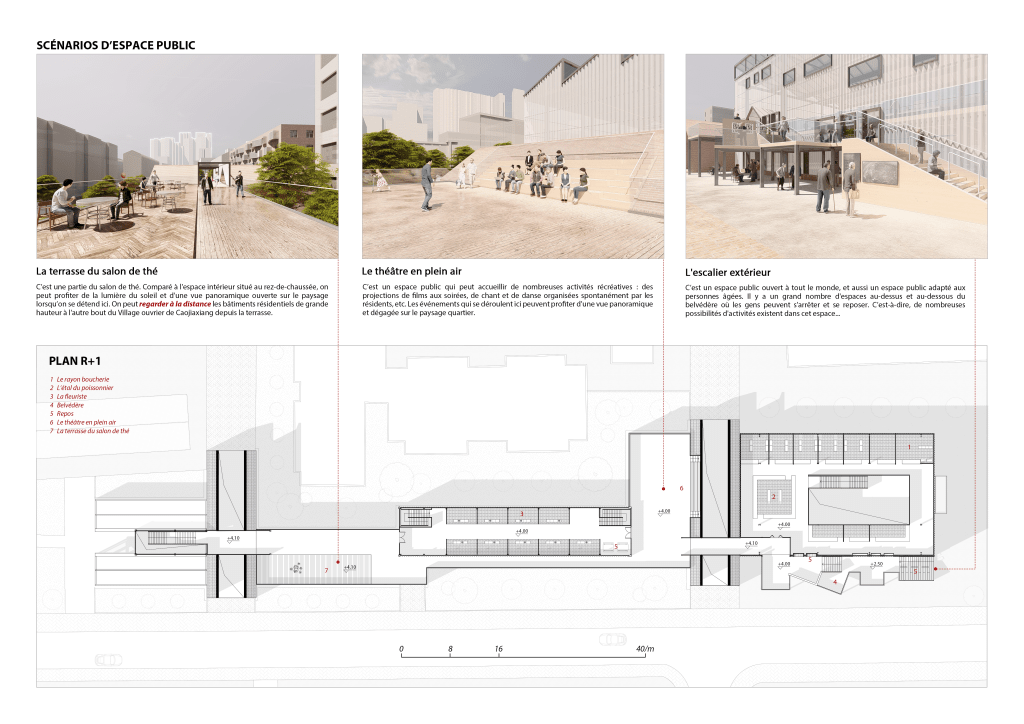
The three scenarios that take place among the programs of the market architecture project each tells the stories where the historical site dialogue in distance with the newly constructed residence building; where people can auto-organize wonderful events in the open-air amphitheater; where residents or visitors can rest themselves spontaneously under the cover of the stair and its platforms.
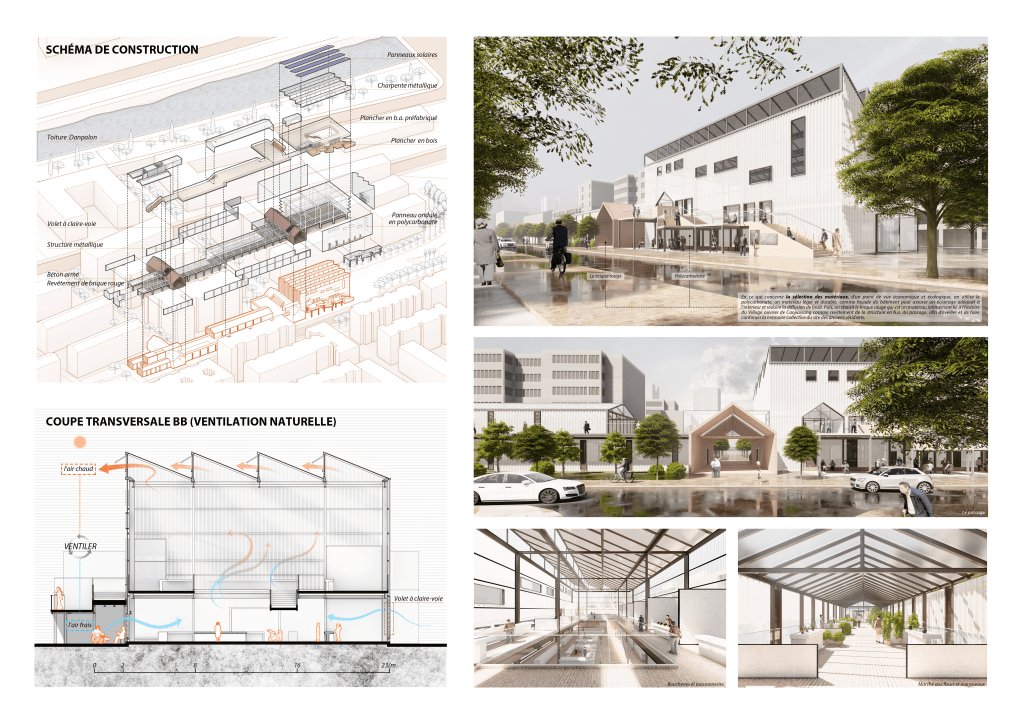
Finally, the spatial form and the relevant structural design of the project respond to a increasingly environmental-friendly pursuit. Also, for material selection, polycarbonate is used for the building facade, balancing economy and ecology. It provides ample interior lighting and minimizes noise. Additionally, red brick cladding on the passage’s concrete structure pays homage to the village’s history, reviving the collective memories and thus fostering a connection to its past residents.
 MA RUI